
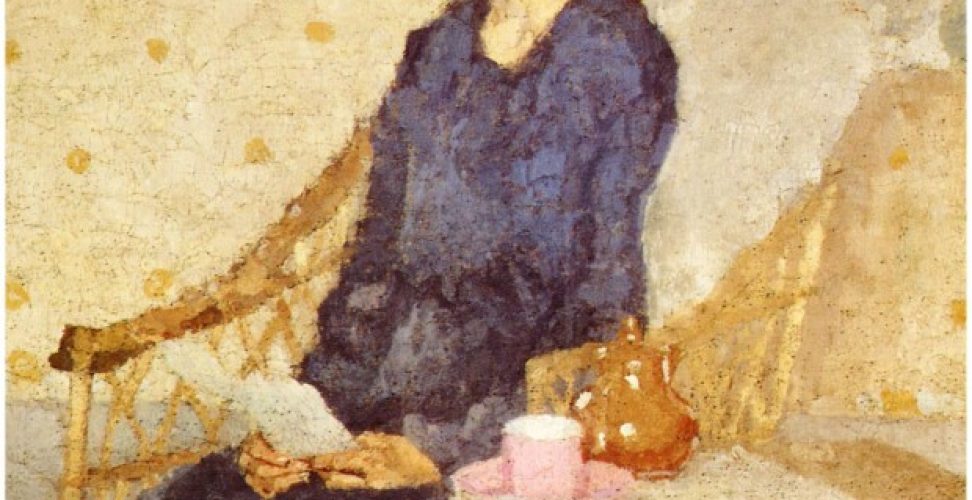
“I think that is a beautiful idea, that we dig out the precious things hidden in us when we paint – and quite true.”
Gwen John
I’ve been drawn to Gwen John as part of our Women’s Art series, not just because she’s Welsh or because she was a much more accomplished artist than her famous brother Augustus John. It’s also because of my own family connection. My cousin studied at the Slade School of Art – many years after the Johns. (Augustus John (1878-1961) died while my cousin was still studying at Slade).
Inevitably, as we’ve found with other research into women artists, Gwen’s brother Augustus has much more written about him. Gus was 16 years old when he entered The Slade School and started his education in the tradition of the Renaissance workshop called “constructive drawing” that has influenced generations of British Art.
He copied Greek, Roman and Renaissance heads and then advanced to life drawing. He made beautiful line drawings of nudes and portrait heads, with sketch books full of arms, legs, and torsos reminiscent of Michelangelo’s own sketches. Henry Tonks, Director of the Slade, once declared that Augustus would be the greatest draughtsman since Michelangelo. He was idolised by other students, with Wyndham Lewis writing:
“…the walls bore witness to the triumph of this
‘Michelangelo’…A large charcoal drawing in the centre of the wall of the
life-class of a hairy male nude, arms defiantly folded and a bristling
moustache, commemorated his powers with almost Gascon assertiveness…”
Augustus John became a larger than life legend. Described at the time as having a ‘wildness’, he swept aside social conventions. He was big in physical build as well as personality.
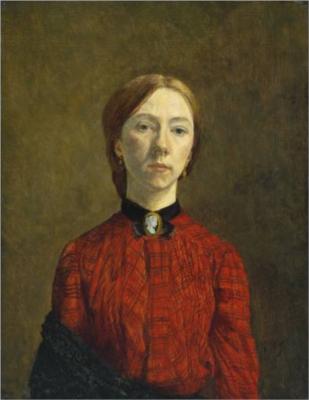
In marked contrast, Gwen John, who arrived at the Slade a year later – encouraged by her brother to join – appeared slight and fragile, dressed in sombre colours and gave a modest impression. This we know hid an extreme determination and strong passions.
Initially she shared rooms in London with her brother, but this did not last. Their attitudes were so different and they frequently upset each other, with Gwen stating: “loneliness is a great thing.” Her energy and passion inevitably manifested itself in her work. Gwen’s brother was a great admirer of her, and after her death stated: “Fifty years after my death, I shall be remembered as Gwen John’s brother”.
During Gwen’s time at the Slade, it was seen as a ‘Grand Epoch’ with a particularly brilliant group of women students including Ida Nettleship, Gwen Salmond and, child prodigy, Edna Waugh. It was predicted Edna would be the second Burne-Jones, to which she famously retorted: “on the contrary I shall be the first Edna Waugh”. But what happened to these brilliant women? Why is there so little written about them when they showed such promise?
Margaret Forster captures more of the whole person of Gwen John in her novel, ‘Keeping the World Away’. It cleverly chronicles a series of women artists (both professional and amateur) through the journey of one of Gwen John’s paintings, initially gifted to her good friend Ursula Tyrwhitt.
Forster tells the story of John’s adventures in Paris, sharing rooms with fellow Slade artists Ida Nettleship and Gwen Salmond. John was very poor, so Salmond smuggled her into the art classes at Académie Carmen where they were both taught by the inimitable American artist and master, James Abbot McNeill Whistler. His methods were in stark contrast to those taught at the Slade. From the beginning he lectured on art as a science: “I do not teach art. I teach the scientific application of paint and brushes.”
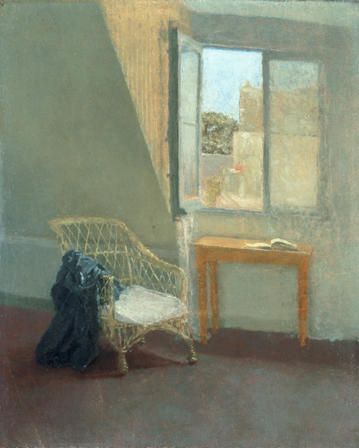
The palette not canvas was their field of experiment and from the very beginning they focused on grinding and mixing colours. It was through this approach that Gwen John learnt structure and orderliness.
To afford classes, John began to pose as a model and she met, modelled and fell passionately in love with Auguste Rodin. John anchored herself in Paris, supported in a small hotel by her lover Rodin, and her new home allowed her to escape the overpowering influence of her brother, Gus, and develop new skills under Whistler’s tutelage.
Then tragically she is discarded by Rodin and never really recovers, ploughing all her excess passion into her painting and living the life of a virtual recluse in Meudon, a south western suburb of Paris. From Gwen John’s diary: “Leave everybody and let them leave you. Then only will you be without fear.”
From the determination and energy of youth through to latter years in desolation, one can’t fail to empathise with Gwen John. Recognised by her peers, never to achieve the commissions and fame of her sibling, overlooked by art history. We hope we can rectify some of that by shining a light on her paintings anew.
Sara McKee
Reading:
Gwen John a Life – Sue Roe
Augustus John – Michael Holroyd
Keeping the World Away – Margaret Forster