
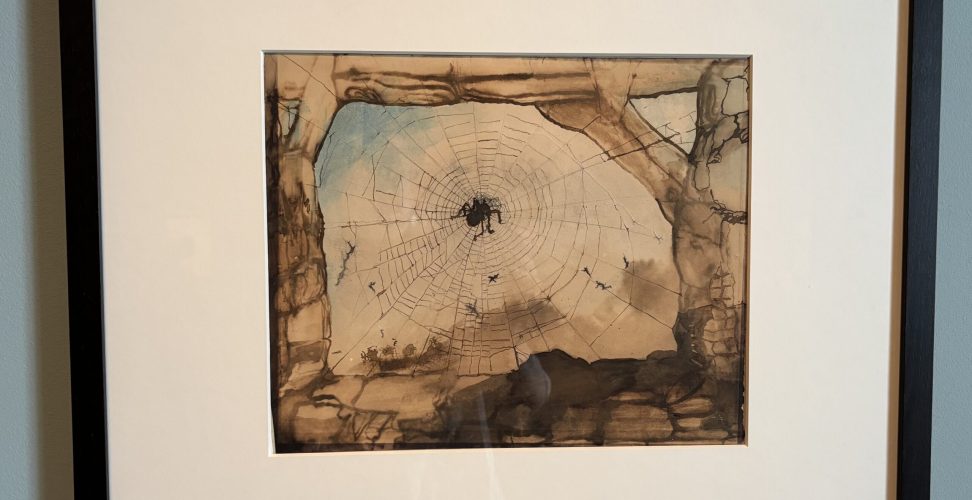
Visiting the Royal Academy’s exhibition of Victor Hugo’s drawings and watercolours felt like stepping into the subconscious of a writer who saw no boundary between the visual and the verbal. Best known for his towering literary achievements, Hugo was also a visionary artist – his ink drawings conjuring entire worlds with the same intensity as his prose.
‘In 1890, Vincent van Gogh compared Victor Hugo’s works to “astonishing things”. It is uncertain whether he had in mind Hugo’s drawings – first exhibited in Paris in 1888, three years after their creator’s death – or passages from his novels such as ‘Les Misérables’ (1862), which Van Gogh read avidly, and whose characters had become part of the cultural landscape. The two never met, but shared ideas about creative kinship across times and disciplines. For them both, writing and drawing were parallel creative processes that enriched one another’ (extract from RA information on the exhibition).
Certain images lingered with me long after I left the gallery. A jagged lighthouse, rising out of dark, storm-tossed ink, stood like a solitary conscience in a world undone. An octopus loomed in another frame—part creature, part symbol—its tentacles curling like sentences searching for meaning. The tension and mystery in these images mirrored the psychological depth of his writing, especially in Les Travailleurs de la Mer, where the sea becomes both adversary and muse.
But it was the more intimate pieces that felt most revealing. A view from Hugo’s writing room, rendered in delicate tones, offered a quiet counterpoint—a moment of stillness, as if we were seated beside him, watching the world unfold beyond the windowpane. And in a web drawn with hair-fine lines, threaded through with a view of a distant town, Hugo fused fragility and perspective. The web could be a metaphor for the creative process itself – tenuous, intricate, yet catching light.
What struck me most was how Hugo used ink not just to depict but to think. These were not illustrations of his literary works, but parallel acts of imagination – unfiltered and instinctive. His fingers, often literally, were in the work. Coffee grounds, soot, and spit joined ink to create textures that feel ancient and elemental.
Hugo’s art reminds us that writing and drawing need not be separate pursuits. Both can spring from the same well – the need to translate feeling into form. In his hands, the pen became a bridge between language and vision, shadow and structure. And perhaps that’s the true legacy of this remarkable exhibition: the invitation to see creativity not as divided disciplines, but as one continuous gesture.
Thoughts from an Art Historian, Sara McKee FRSA