
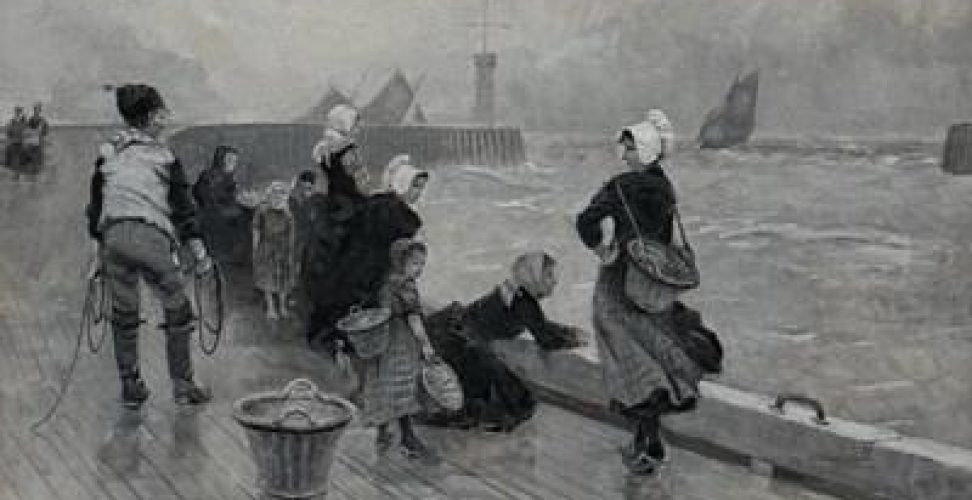
The Next Custodian
Some discoveries are made not in galleries, but in sale rooms.
HECTOR CAFFIERI (British, 1847-1932) watercolour en grisaille – Breton fish girls waiting at a quayside, signed.
Sale rooms are curious places. Every object waits with the same patient dignity, whether it is a masterpiece or merely a forgotten possession. The greatest discoveries seldom announce themselves. They sit quietly beneath dusty glass, waiting for someone willing to look a little longer.
That was how I first met Hector Caffieri.
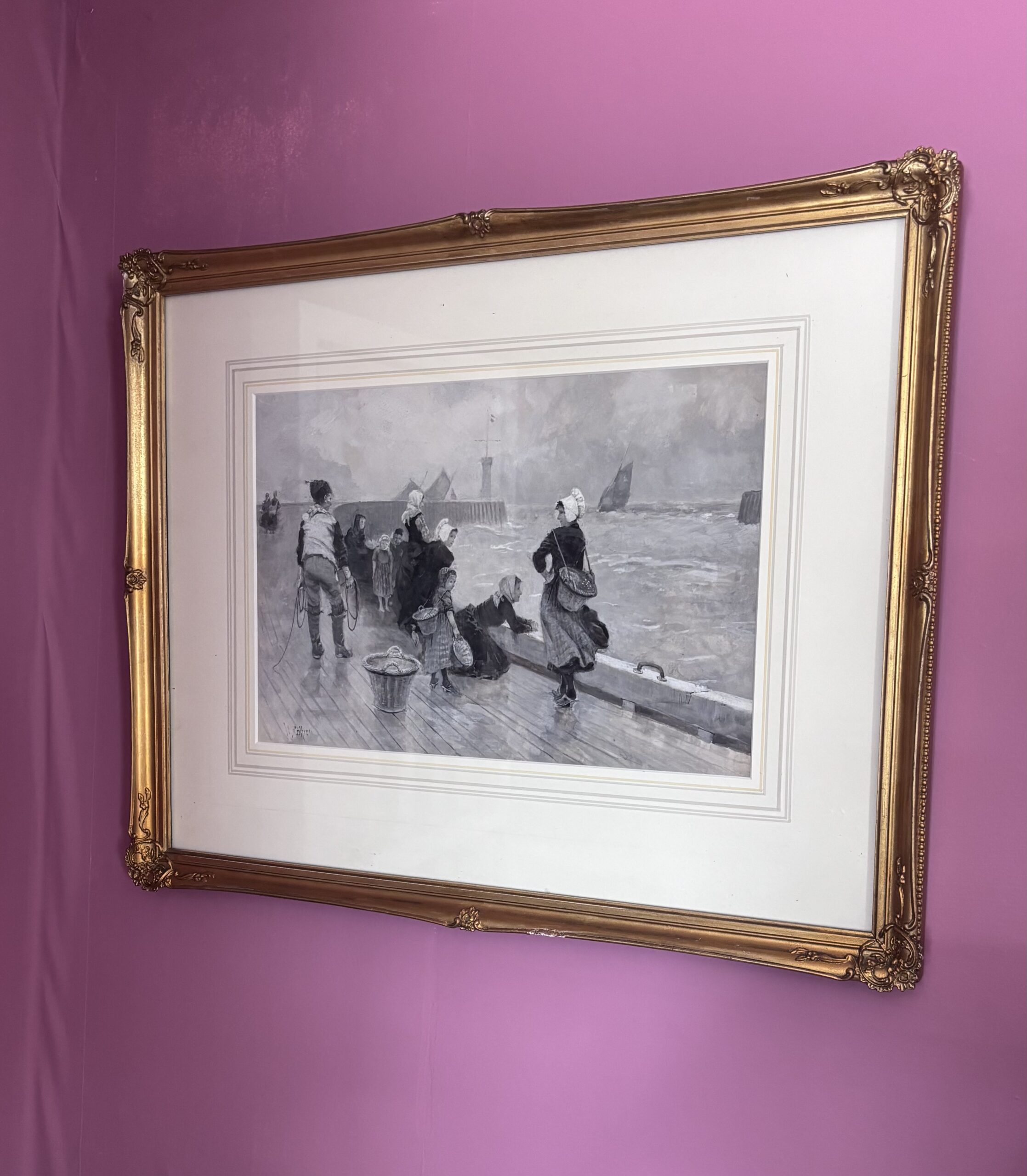
Across the room, amidst furniture, porcelain and the familiar miscellany of an estate sale, hung a modest watercolour rendered almost entirely in shades of silver and pearl. At first glance it appeared restrained, almost monochrome, but as I moved closer the picture slowly awakened. Fisherfolk gathered on a weathered quay; children lingered beside their mothers; one woman leaned expectantly over the harbour wall while dark sails emerged through sea mist beyond the breakwater. The entire scene breathed the salt air of the French coast.

Painted in grisaille, where colour gives way to tone, light and atmosphere, it possessed an extraordinary quietness. There was no theatrical drama, only the poetry of everyday life.
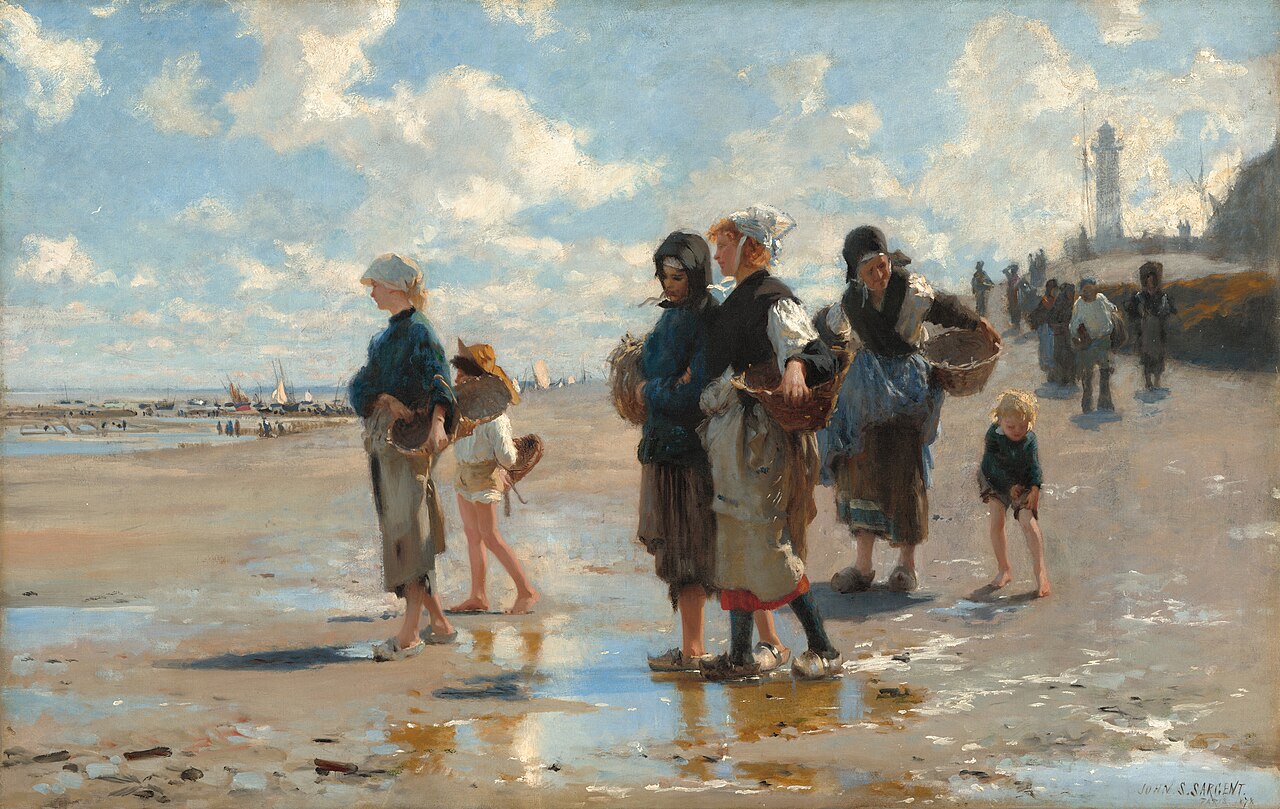
As I stood before it, another image drifted into my thoughts: John Singer Sargent’s Oyster Gatherers of Cancale. Painted on a different stretch of the French coast, it shares the same gentle reverence for working people and the rhythms of the sea. During the closing decades of the nineteenth century, many artists were beginning to turn away from grand historical narratives and formal commissions in search of something more truthful. They found it not in palaces or battlefields, but amongst fishermen, market women, oyster gatherers and families whose lives were governed by tide, weather and hard work. These quiet scenes of ordinary existence proved every bit as compelling as the grand subjects that had long dominated the Salon.
Hector Caffieri belonged naturally to this changing artistic landscape. Born in Cheltenham in 1847 to French parents, he trained in Paris at the Académie Julian under the distinguished academic painters Léon Bonnat and Jules-Joseph Lefebvre. His education equipped him with all the technical accomplishments expected of a successful professional artist, and he exhibited widely, including at the Royal Academy in London, the Royal Institute of Painters in Water Colours and the Royal Society of British Artists.
Yet it was not fashionable portraiture or academic subjects that ultimately defined him. Instead, the fishing port of Boulogne-sur-Mer became both his home and his enduring inspiration. There, among bustling quays, returning fishing boats and families whose livelihoods depended upon the sea, Caffieri discovered subjects that resonated deeply with him. Like Sargent on the beaches of Cancale, he recognised that dignity could be found in the simplest human moments: women waiting for boats to return, children watching the harbour, conversations carried on against the endless sound of wind and waves. His paintings celebrate not spectacle but observation, revealing an artist who found beauty in lives that many would have passed without a second glance.
The auctioneer devoted scarcely more than a sentence to the picture.
The hammer fell.
And in that quiet instant I became not its owner, but its next custodian.
There is a comforting thought in collecting original works of art. We never truly possess them. We simply care for them for a while before they continue their journey into another generation. Before me, others had paused before this same watercolour, perhaps seeing in it memories of their own travels or lives by the sea. Long after me, someone else may stand before it and discover something entirely different.
Now the painting hangs against a rose pink background, where changing daylight gently reveals new subtleties each morning. Sometimes it is the confidence of a single brushstroke describing the folds of a fisherwoman’s shawl. Sometimes it is the glistening timber of the rain-soaked quay. Often it is simply the atmosphere itself—that soft veil of mist dissolving the boundary between sea and sky—which seems to draw me into the scene.
The excitement of discovering an overlooked painting in a sale room lasts only a few moments.
The pleasure of living with it lasts far longer.
But perhaps the greatest satisfaction comes from sharing it.
For Caffieri painted this scene not as a curiosity but as a tribute to ordinary people whose lives were shaped by the sea. More than a century later, their quiet humanity still speaks to us. By telling their story, and by passing on the story of the artist who chose to paint them, we become part of the same conversation that began on a windswept quay in Boulogne.
That, perhaps, is the true reward of collecting, not simply acquiring beautiful objects, but discovering overlooked voices and ensuring they continue to be heard.
Even more inspiration for my writing both as art history and storytelling. Happy Reading.
Sara McKee FRSA
Art Historian and Writer