
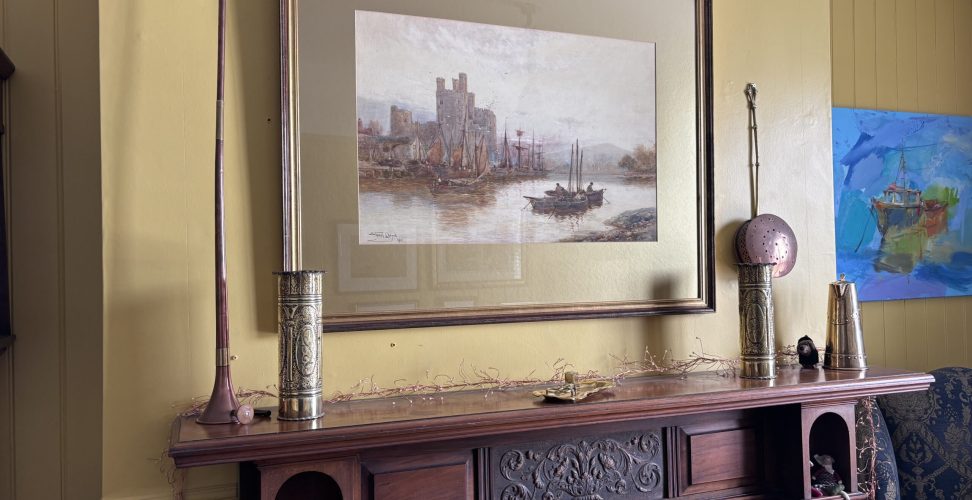
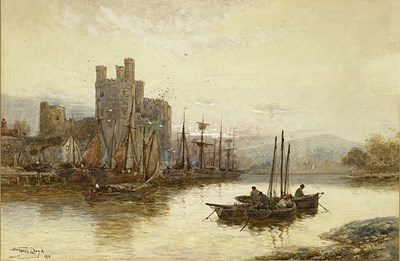
Since I first moved to Caernarfon and opened my art gallery in Hole in the Wall Street I have felt as if I am walking through history every day. With our imposing castle, impregnable stone walls and historic buildings I can almost hear the voices of our ancestors. That’s why I’m drawn to the fine art I’ve been collecting recently for our Life: Full Colour gallery at Y Segontiwm. Pieces that reflect our shared history down the centuries. Like this magnificent piece by Stuart Lloyd of Caernarfon Castle and its fishing boats dated 1911.
There is something particularly evocative about Stuart Lloyd’s watercolour of Caernarfon. Lloyd captures something much larger than a picturesque view of the town. He paints a living Caernarfon in 1911.
The looming castle forms a familiar backdrop, but Lloyd’s attention is drawn towards the water: fishing boats and sailing vessels gather in the foreground, with tiny figures going about their business. The boats are not simply decorative additions to a landscape. They are the reason this painting feels so personal. They tell us something about the people and working life of the town at the beginning of the twentieth century.
Lloyd was a successful British landscape and marine painter, exhibiting at the Royal Academy and becoming a member of the Royal Society of British Artists at a remarkably young age. He was particularly drawn to rivers, harbours, boats and the meeting point between landscape and everyday work.
And Caernarfon offered him a remarkable subject.
By 1911, the waterfront was the product of generations of industry and enterprise. The slate trade had transformed the landscape of North Wales, connecting mountain quarries with railways, ports and the wider world. Caernarfon’s quays were part of this network, while smaller boats and fishing vessels formed another important strand of maritime life.
Today, this wider story is recognised by UNESCO through the Slate Landscape of Northwest Wales World Heritage Site, inscribed in 2021. UNESCO describes it not simply as a collection of quarries, but as a cultural landscape encompassing ports, harbours, railways, settlements and the communities whose lives were transformed by the slate industry.
That UNESCO perspective changes the way we look at Lloyd’s painting. The castle is no longer simply an ancient monument placed behind a picturesque harbour. It becomes part of a much larger landscape: one shaped by work, trade, industry and the sea. And behind every boat was a person.
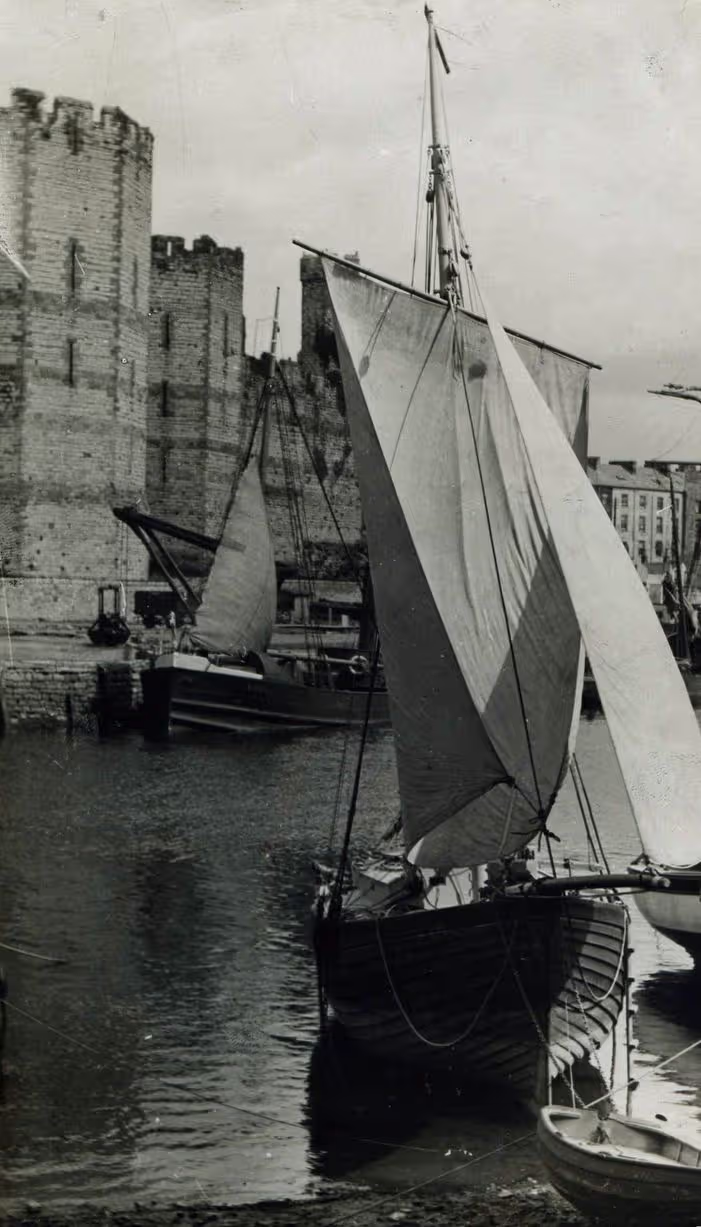
Gwynedd Archives preserves records relating to the area’s maritime history, while the Caernarfon Record Office holds more than eight centuries of local documents, photographs, maps and newspapers. These collections offer glimpses into the lives of the people who worked on the waterfront and the vessels that served the town.
Perhaps this is what makes Lloyd’s watercolour so appealing today. He did not paint Caernarfon as an empty historical monument. He painted it with people, boats and movement.
His castle is ancient; his boats are vulnerable; his water is constantly changing.
Together they create a portrait of a Welsh town at a particular moment in time — a moment when an older maritime world was still very much alive. And more than a century later what we’re really looking at is a snapshot in time of Caernarfon itself.
The painting currently hangs above our Georgian fireplace at Y Segontiwm facing out across to the scene today. Visit us to look closely and perhaps make it yours for the years ahead: Stuart Lloyd’s Caernarfon, 1911: The Castle, the Boats and a Working Waterfront
I look forward to welcoming you to our house on Segontiwm Terrace as the building reaches its 200th year in Caernarfon.