
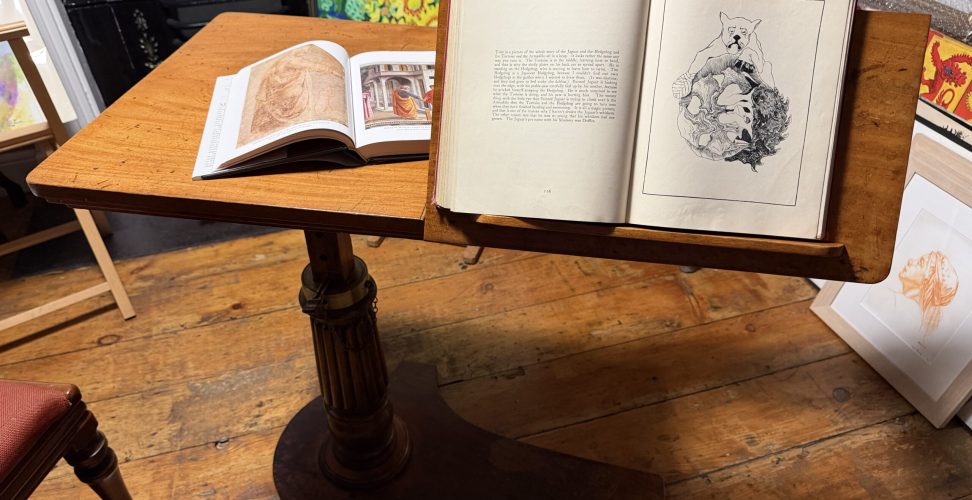
There is something rather special about furniture that has been designed around the simple pleasure of reading. And this handsome Victorian reading stand is a particularly fine example of how our ancestors found ways to make the experience of engaging with books both comfortable and elegant.
With its beautifully turned and fluted wooden column, rich dark timber, substantial shaped base and brass adjustment fittings, this is a piece that combines practical ingenuity with the decorative craftsmanship of the nineteenth century. It is not difficult to imagine it standing beside a favourite reading chair in a gentleman’s library, supporting a substantial volume of literature, history or perhaps an illustrated work of natural history.
The nineteenth century witnessed an extraordinary expansion in the world of books. Advances in printing, growing literacy and the increasing availability of published works transformed reading from an activity largely associated with the privileged few into an increasingly popular pursuit.
At the same time, the private library became an important feature of the Victorian home. For wealthy industrialists, merchants, professionals and country-house owners, a library was more than somewhere to keep books. It was a place for contemplation, correspondence, study and intellectual conversation.

Furniture evolved to meet these changing habits. Reading stands, adjustable book rests and lecterns allowed readers to enjoy large or heavy volumes without having to hold them. They were particularly useful for illustrated books, reference works, manuscripts and lengthy publications that invited prolonged attention.
This example has an especially appealing combination of form and function. The substantial turned column provides an architectural quality, while the brass fittings and adjustable construction demonstrate the Victorian enthusiasm for mechanical ingenuity and useful domestic inventions.
It is tempting to consider the sort of surroundings in which this stand might once have been found.
Manchester provides an especially interesting possibility. During the Industrial Revolution, fortunes were made through manufacturing and commerce, and many successful industrialists established impressive country houses with libraries reflecting their interests, ambitions and intellectual curiosity.
The city’s literary heritage also offers some wonderful points of reference. The Portico Library, established in 1806, became an important meeting place for Manchester’s readers and thinkers. Its nineteenth-century collections provide a remarkable insight into the intellectual life of a rapidly developing industrial city.
Further along Deansgate, the magnificent John Rylands Library opened in 1900. Founded by Enriqueta Rylands in memory of her husband, the Manchester industrialist John Rylands, it represents the extraordinary Victorian ambition to preserve and make knowledge accessible for future generations.
And in North Wales, Gladstone’s Library at Hawarden offers perhaps an even more personal connection. Founded by William Ewart Gladstone, it grew from his own extraordinary collection of books and his belief that knowledge should be shared. There is something particularly appropriate about imagining a Victorian reading stand finding a new home in a Welsh institution devoted to the enduring importance of books and scholarship.
Today, in an age when so much reading takes place on screens, there is a renewed pleasure in the physical experience of books. Large illustrated volumes, antiquarian publications, exhibition catalogues and beautifully bound first editions deserve to be displayed and enjoyed.

A Victorian reading stand offers an elegant solution, whether placed in a private library, a study, a country house or a historic institutional setting. It is equally at home supporting an important volume for leisurely reading or forming part of a carefully curated collection of nineteenth-century furniture.
At Life: Full Colour, we are particularly interested in objects that carry something of their previous lives with them. This is one such piece: a functional object made beautiful through craftsmanship, and a reminder of a time when the pleasures of reading were given their own special place within the home.
Perhaps its next chapter should be written in the company of someone who truly appreciates the history of books.
Available from Life: Full Colour – Art & Antiques Gallery, Y Segontiwm, Caernarfon.
We would particularly welcome enquiries from bibliophiles, private collectors, interior designers and historic libraries interested in acquiring an unusual and characterful example of Victorian library furniture.